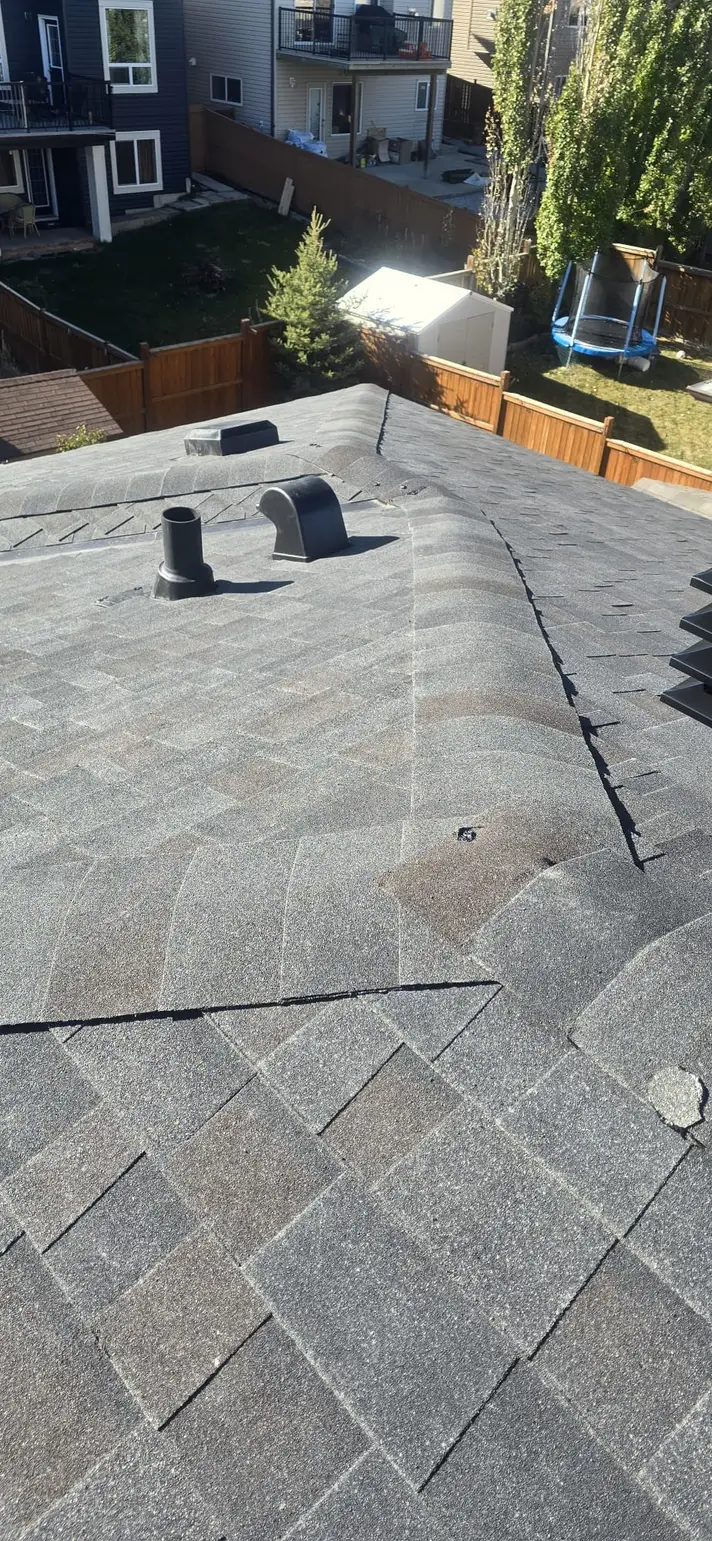

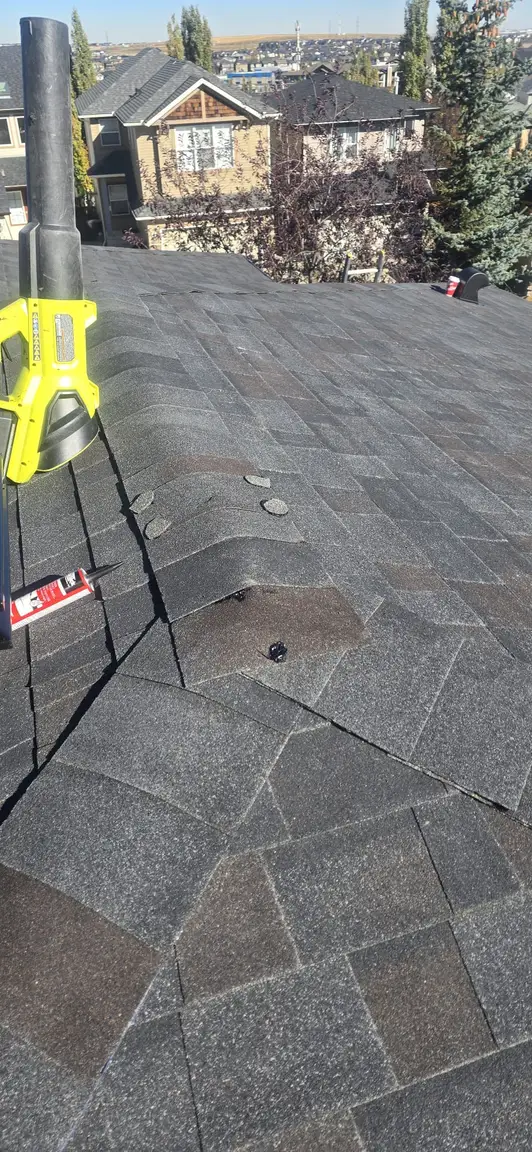
Hail damage on asphalt shingles shows as indentations, fractures or circular bare spots where granules were knocked loose, and the bare spots can take several months to appear. Dented vents, eavestroughs and meter boxes confirm the strike. Manufacturer warranties exclude hail, so the claim goes to the home insurer, which needs dated photographs and a written inspection report.
Quick facts
- What hail leaves. Indentations, fractures, or multiple circular areas on the shingle where granules are missing; severe strikes crack the shingle and weaken its water shedding.
- Delayed marks. Circular or slightly elliptical bare areas may take several months to appear as loosened granules fall away.
- Witness marks. Where shingle damage is not visible, look for indentations on vents, gutters, siding, air conditioning units, heat pumps and electric meter boxes.
- Normal granule loss. Loose “hitchhiker” granules from manufacturing fall off and are not a defect; Malarkey puts the period at six months to two years, IKO at the first few years.
- The real threshold. Granule loss matters only when bare spots of coating asphalt are exposed.
- Hail is excluded. IKO’s Canadian limited warranty lists hail among excluded acts of God; CertainTeed’s limited warranty excludes damage caused by hailstorm and by impact from tools, equipment or foot traffic.
- Notice windows. IKO and CertainTeed both require a warranty claim within 30 days of discovery; IKO asks for clear colour photographs and two complete sample shingles.
- Class 4 test. A Class 4 shingle withstands a 2 in steel ball dropped from 20 ft.
What does hail damage look like on asphalt shingles?
Hail damage is a pattern of indentations, fractures and round bare patches, not a general thinning of the surface. The marks are indentations, fractures, or multiple circular areas on the shingle where granules are missing.
In severe cases the impact cracks the shingle, which weakens the roof’s ability to shed water. The hailstone breaks or weakens the bond between the granules and the asphalt beneath them.
You often cannot see the damage on the day of the storm. Owens Corning states that the effects may not be immediately apparent, and that it can take several months for circular or slightly elliptical areas to appear as the loosened granules dislodge.
Once asphalt is exposed, ultraviolet radiation accelerates its oxidation and ages the shingle early. Calgary sits at about 1,045 m with strong summer UV, so an exposed bruise ages quickly here.
Soft metals record the strike when shingles do not. Look for indentations on vents, gutters, siding, air conditioning units, heat pumps, electric meter boxes and other metal objects as telltale signs of hail. Those dents also fix the size and direction of the hail, because ageing or foot traffic cannot produce them. Hail falls in random patterns and may damage only a few houses in a neighbourhood, so a neighbour’s intact roof does not clear yours.
How can I tell hail damage from normal wear?
Normal wear removes granules evenly and slowly; hail removes them in round patches with an indentation beneath. Some normal granule loss is often mistaken for damage.
Malarkey explains that more granules than necessary are pressed into the hot asphalt at the factory, that most of the excess “hitchhikers” are reclaimed, and that the rest fall off in the first six months to two years, usually into the eavestroughs.
The loss is not a manufacturing defect and continues at a lower rate for the life of the roof. Malarkey also notes that granules in gutters may be from the previous roof if the gutters were not replaced.
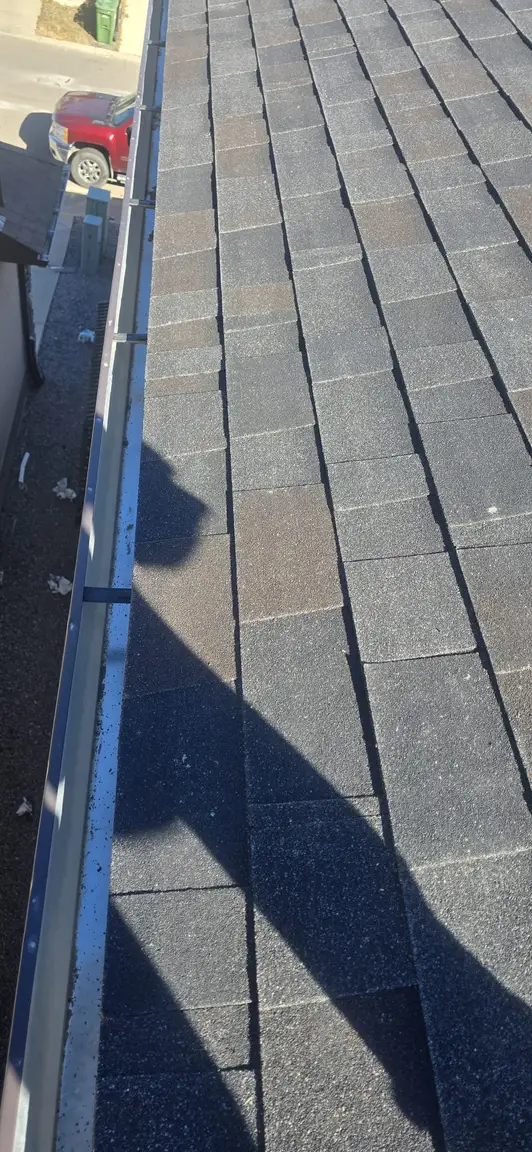
IKO says the same of its shingles: hitchhiker granules come off during the first few years of exposure, the loss is normal, and it does not shorten the weatherproofing life.
IKO sets the threshold that matters: granule loss becomes a performance concern only when bare spots of coating asphalt are exposed on the surface. Malarkey adds that daily heating and cooling cycles cause some loss throughout the life of the shingle, which in Calgary means every chinook.
Other causes mimic hail. Malarkey lists high winds, hail, ice dams and inadequate ventilation as events that cause significant granule loss.
The warranties name foot traffic: CertainTeed’s limited warranty excludes damage caused by impact from wind-blown objects, tools, equipment or foot traffic, and IKO’s Canadian warranty excludes damage from people, animals, machinery, equipment or any traffic on the roof.
Scuffed granules along a walking line, around a satellite dish or below a ladder point are traffic, not hail. Blistering is a separate shingle condition.
Shape separates hail from wear: a round bare patch with a dent beneath it is a strike, while even thinning is ordinary weathering and granules in the eavestrough settle nothing. Some patches arrive late, so timing comes next.
How soon after a storm should the roof be inspected?
Inspect promptly, then again after a few months, because hail damage has both an immediate and a delayed picture. Owens Corning tells owners that in the aftermath of a hailstorm it is important to have the roof checked by a professional roofing contractor who can inspect safely and thoroughly.
Malarkey recommends a professional roof inspection after extreme weather events, naming hail storms and high winds. Roof access is dangerous; the manufacturers direct the inspection to a contractor, not the homeowner.
The timing also builds a record. IKO’s and CertainTeed’s warranties both run on a 30-day clock: IKO requires the owner to contact its warranty services within 30 days of becoming aware of a concern, and CertainTeed requires notice within 30 days of discovery. Those clocks apply to manufacturing defects, not hail, but they set a reasonable standard an insurer will recognize for prompt reporting.
The deadline that binds an insurance claim is the one written in the owner’s own policy, so the owner should read its notice and proof-of-loss conditions and report the damage to the insurer or broker as soon as it is found.
An inspection in the first days records the storm date, and a second look after the several-month lag Owens Corning describes catches bruises that have since shed their granules.
Core Armour Exteriors is a local Calgary roofing company, not an out-of-town storm chaser: here before the storm and long after it. That counts when the second look comes months after the first.
Hail or not hail: reading the signs
The table pairs each sign with its likely cause.
| Sign on the roof | Hail | Not hail |
|---|---|---|
| Round or slightly elliptical bare spot with an indentation under it | Yes, the typical hail mark | not stated |
| Fracture or crack through the shingle after a storm | Yes, in severe strikes | Also foot traffic or dropped tools, which the warranties exclude |
| Dents on vents, eavestroughs, siding, meter boxes | Yes, witness marks of hail size and direction | not stated |
| Granules in eavestroughs or at downspout outlets in the first two years | Possible after a storm | Normal hitchhiker loss for six months to two years |
| Even, gradual thinning of granules across whole slopes | not stated | Normal weathering from daily heating and cooling |
| Scuffs in a line or around equipment | not stated | Traffic on the roof, excluded by both warranties |
| Bare asphalt spots with no storm in the record | not stated | Possible manufacturing matter; Malarkey directs these to its warranty department |
| Damage on some houses in a street but not others | Consistent with hail’s random pattern | not stated |
How do I document hail damage for an insurer?
Document the date, the witness marks and the shingle damage in that order, in writing and with photographs. The manufacturer warranty claim process is the closest model.
IKO asks for a valid proof of purchase identifying the shingle model, quantity and date, clear colour photographs, two complete sample shingles that show the condition, and access to the roof and attic for inspection, photographs and sampling.
CertainTeed asks for proof of ownership and the date of purchase and application, and may require a shingle sample and permission to photograph and sample the roof.
A sound inspection report follows a set form. The inspector works by visual observation, issues reports in a timely manner (usually within a day), records any damage to the roof in a daily report, and certifies the final condition in writing.
A hail report for a Calgary insurer should match that form: the storm date, the inspection date, photographs of each slope and of the dented metals, a count or map of strikes per test area, and the inspector’s signature.
As a cost guide, one 2026 Calgary roof inspection with a written photo report was billed at $800 before GST; that is a single example, not a market average.
What do the warranties say about hail?
They exclude it. IKO’s Canadian limited warranty covers only manufacturing defects that significantly affect water shedding. Its exclusions include any damage caused by acts of God, naming lightning, gale or wind (except under its wind warranty), hail, hurricane, tornado, earthquake, explosion, flood and solid objects falling on the roof.
CertainTeed’s limited warranty excludes damage caused by lightning, hailstorm, earthquake, fire, explosion, flood or falling objects, and separately excludes impact from wind-blown objects, tools, equipment or foot traffic.
Owens Corning says the same, even for its impact-rated lines. Damage caused by hail is not covered by its standard product limited warranty or its extended protection warranties, and hail damage is specifically excluded even for shingles classified UL 2218 and FM 4473 Class 4.
CertainTeed’s warranty points the owner where the cost goes: in its wind section it notes that costs beyond the manufacturer’s material contribution are the property owner’s responsibility and may be covered by the owner’s insurance. The same logic applies to hail.
Can hail damage be repaired or does the roof need replacing?
Manufacturers do not set a strike count that triggers replacement, but two conditions decide it. Owens Corning distinguishes a cracked or fractured shingle, which weakens water shedding and is a leak risk, from a bruise that has shed granules, which exposes asphalt to UV and shortens the shingle’s life.
A roofer can patch a roof with scattered cracks shingle by shingle; a roof with bruising across every slope has lost its UV protection in hundreds of places and ages early as a whole.
For replacement in a hail-prone area, Owens Corning recommends impact-resistant shingles tested to UL 2218, where Class 4 means withstanding a 2 in steel ball dropped from 20 ft, and states that Class 4 shingles help to prevent or reduce the amount of damage. It adds that Class 3 and Class 4 ratings may qualify for an insurance discount, and that higher classes often yield higher discounts.
The guide on what a roof replacement quote should include shows where Class 4 shingles fit. Whichever route you take, Malarkey’s and Owens Corning’s advice is the same: a professional inspection after the storm, before any decision.
What this means for a Calgary roof
Calgary’s hail season runs June to August, with hail possible from May to September, and the August 2024 storm was among the costliest insured events in Canadian history. So a Calgary roof should be inspected after any hailstorm and again a few months later, because bruises can take several months to show.
Granules in the eavestroughs in the first two years after a new roof are normal, but round bare spots and dented vents are not. Core Armour Exteriors inspects hail damage, writes the dated report an insurer expects and repairs or replaces hail-damaged roofs as the findings dictate; call (587) 580-9034.
Questions people ask
When is Calgary hail season?
Hail season in Calgary runs June to August, and hail can fall from May to September. Hail falls in random patterns, so one storm can damage a few houses on a street and leave the rest untouched.
Does a manufacturer warranty cover hail?
No. IKO’s Canadian warranty and CertainTeed’s warranty both exclude hail, and Owens Corning excludes hail even on its Class 4 shingles. Warranties cover manufacturing defects that affect water shedding; storms are insurance matters.
Does insurance cover hail damage to a roof in Alberta?
The manufacturers send hail losses to the home insurer, and CertainTeed’s warranty states that costs beyond its material contribution may be covered by the owner’s insurance. Policy terms vary, so what your insurer pays depends on your policy.
Why are there granules in my eavestroughs after a new roof?
They are hitchhiker granules, the surplus pressed into the asphalt at the factory. Malarkey says they fall off over six months to two years and IKO says the first few years; both state the loss is normal and only exposed bare asphalt is a concern.
Is a Class 4 shingle the answer after hail damage?
Owens Corning recommends impact-resistant shingles for hail-prone areas and states that Class 4 helps prevent or reduce damage, while every maker excludes hail from the warranty. It reduces risk and may earn an insurance discount; it does not make the roof hail-proof.
What should a hail inspection report contain?
Following the standard inspection form and the manufacturers’ claim requirements: the storm and inspection dates, photographs of each slope and of dented metals, the location and count of strikes, sample shingles where a warranty question exists, and a signed written conclusion.